
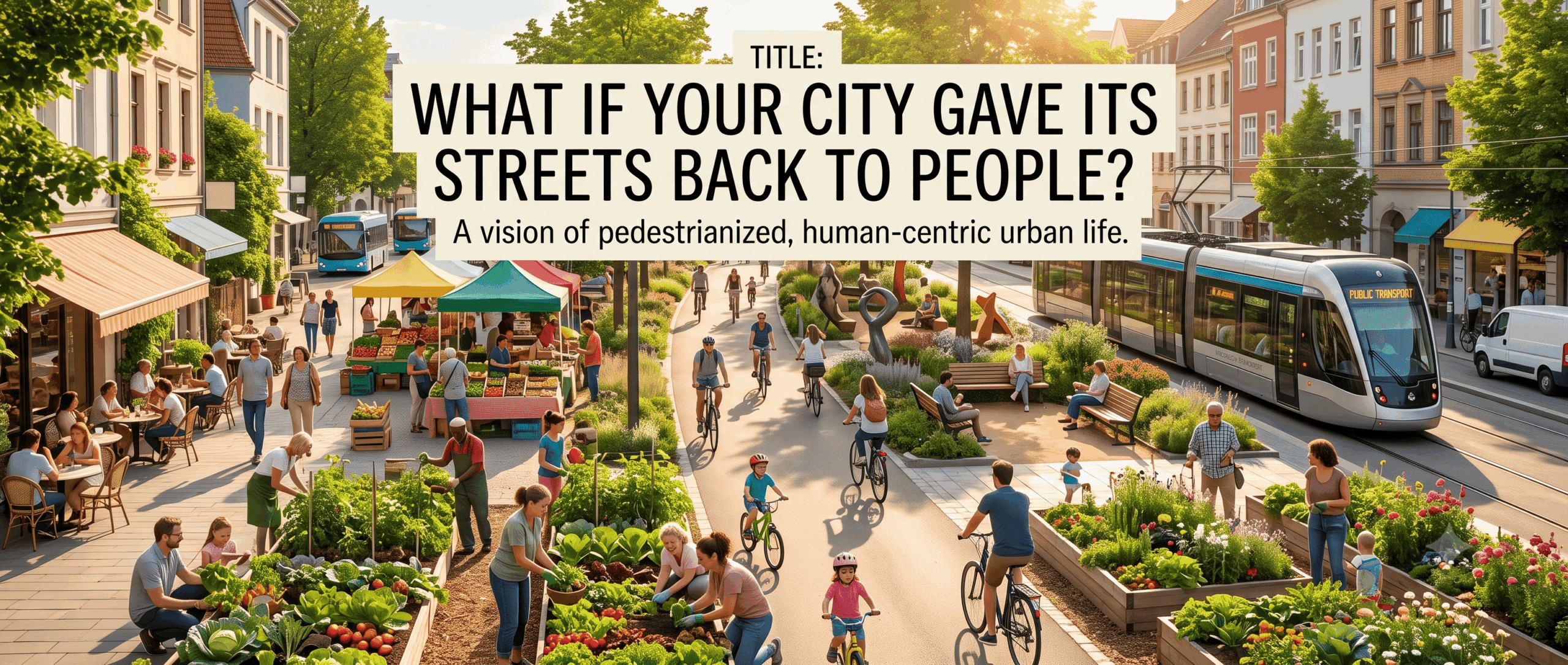
Usually, the sound would disappear beneath engines and impatient horns. Today, you can hear the wheels of a shopping trolley, a café opening its shutters, and two neighbors arguing cheerfully about the weather.
The road outside your building has become a place you can stand in.
Imagine a city where private cars gradually disappear from everyday travel. Buses still run. Emergency vehicles still have clear routes. Deliveries arrive at scheduled times. But most of the space once used for driving and parking now has another purpose.
Your journey to work would change. So would the view from your window.
On your first morning, you might leave home earlier than usual. The familiar calculation—traffic, parking, another ten minutes just in case—would need replacing.
Perhaps you would walk to a tram stop through a small square that used to be a junction. Perhaps you would cycle along a route wide enough to ride beside your child. On a rainy day, you might take a neighborhood shuttle.
Whether any of this felt pleasant would depend on ordinary details. A bus that comes every forty minutes would make the new city exhausting. A sheltered stop and a dependable service could make it feel easy.
People would need those alternatives working before handing over their car keys.
Then there would be the question of what to do with all the space.
Outside your apartment, six parking spaces might become a garden with a bench around a tree. Near a school, a former turning lane could become a place where parents wait and children finish conversations before going home.
Some streets might host markets. Others could remain mostly open, with enough room for wheelchairs, bicycles, delivery carts, and people who simply walk slowly.
There would be arguments.
The café owner might want more outdoor tables. Residents upstairs might prefer quiet. Teenagers might ask for somewhere to gather without having to buy anything.
Every block would have to decide what shared space actually meant.
Shopping would change in small, practical ways. Carrying a week’s groceries across town would still be inconvenient, especially in heavy rain. Neighborhood shops, cargo bikes, and affordable delivery services could help, but they would need to suit people with different incomes and abilities.
A hardware store might lend customers a trolley. An apartment building could have a shared delivery room. Furniture deliveries could use bookable access periods.
Even an imaginary city needs a sensible answer to the question, “How am I getting this refrigerator home?”
The most demanding test would be whether everyone could move around comfortably.
A healthy adult might enjoy a fifteen-minute walk. Someone with chronic pain could find the same journey difficult. A parent traveling with two small children would have different needs from a student carrying a backpack.
Accessible shuttles, frequent seating, smooth pavements, and transport close to people’s doors would have to be part of the original plan.
The city would also extend beyond its pleasant center. A cleaner, quieter downtown would offer little comfort to a night worker stranded in an outer neighborhood after the last bus.
By evening, though, you might notice a change you had barely considered.
You recognize more people.
There is the man who reads outside the bakery. The woman whose dog always stops beside the fountain. The children who have invented a complicated game around three painted circles on the pavement.
You are still busy. You still have errands, messages, and somewhere to be.
But when you arrive home, you sit outside for a few minutes.
Across the street, someone brings out another chair. A neighbor asks whether you have eaten. The bakery is closing, and the owner is carrying a bag of leftover rolls.
Tomorrow, there will be another meeting about delivery hours.
Tonight, you stay until the streetlights come on.